

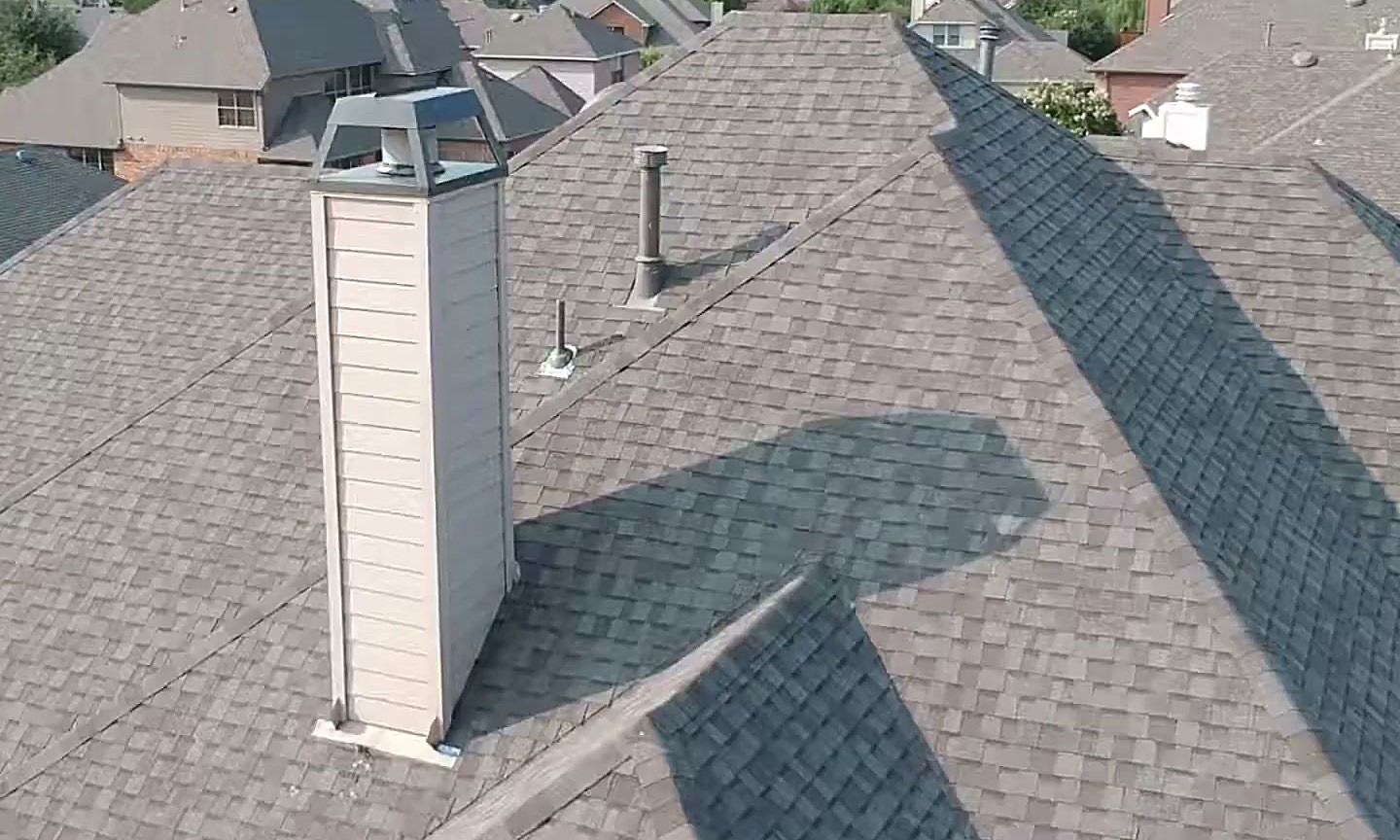
How do I know if hail damaged my roof?
Usually you cannot tell from the ground, and that is the problem. Hail bruises a composition shingle by knocking granules loose and fracturing the mat underneath, and a bruised roof does not leak that week. Reliable ground-level signs are dents in soft metal, gutters, downspouts, vent caps and flashing, and a scatter of granules at the bottom of a downspout. The roof itself needs somebody on it.
A hail bruise is a wound, not a hole
A composition shingle is a fiberglass mat coated in asphalt with ceramic granules embedded on top. The granules are the sunscreen. They take the ultraviolet so the asphalt does not, and asphalt without them gets brittle and cracks.
When a hailstone hits hard enough, it knocks a patch of granules off and fractures the mat beneath. The shingle is still there, the roof is still watertight, and nothing about it looks wrong from the street. What has changed is that a patch of the mat is now taking direct sun. Two or three years later it cracks, and the roof starts leaking in weather that would never have bothered it before.
That delay is the single most expensive thing about hail. Insurance policies have deadlines for reporting storm damage, and a roof that starts leaking three years after the storm that ruined it is frequently a roof nobody is going to pay to replace.
What you can see from the ground
Soft metal dents before shingles bruise, which makes it the useful tell. Look at gutters and downspouts, at the aluminum caps on turbine and box vents, at flashing, at the fins on an outdoor air conditioning unit, at a metal mailbox, at the garage door. Dents on those mean stones came down with enough energy to matter.
Then look at the bottom of a downspout. A drift of granules like coarse sand is normal in very small quantities on a new roof and abnormal in quantity on an old one.
The other reliable signal is social. If several neighbors are getting roofs replaced, the cell came through your street, and hail cells are notoriously local. One side of a road can be hit and the other side untouched.
What an inspector is looking for up there
The test is a hit pattern. Random impact marks spread across every slope with the granules displaced and a soft, bruised feel under a thumb is hail. Damage in a line, or only on one slope near a tree, is almost always something else.
Direction matters too. Hail comes in with the wind, so the slopes facing the storm usually take it worst, and an inspector will compare faces rather than judging one.
Age complicates it. An old roof shedding granules from ordinary weathering can look superficially similar, and telling the two apart is a large part of why insurers train adjusters to a standard. HAAG certification is that standard, and it is what both sides of a claim are arguing from.
What to do about it and in what order
Get the roof inspected and get the findings in writing with photographs. If there is damage, that report is what the claim is built from, and a thin one is the usual reason a claim gets denied.
Do not let anybody start work before the carrier has seen it, and be wary of a contractor who offers to cover your deductible. Waiving a deductible is insurance fraud in Texas and it is the offer that most reliably identifies a company that will not be here next year.
Related questions
How long do I have to file a hail claim in Texas?
It depends on your policy, and many require prompt notice. The practical answer is that the sooner the damage is documented the easier the claim is, and a storm several years back is a much harder argument than one from this spring.
Will my roof leak straight after hail?
Usually not, which is exactly what makes hail expensive. The leak arrives once the exposed mat has taken enough sun to crack, often two or three years later.
Does a metal roof get hail damage?
It dents rather than bruises. Whether the dents are cosmetic or functional depends on the gauge and the profile, and a dented metal roof is often still doing its job.