

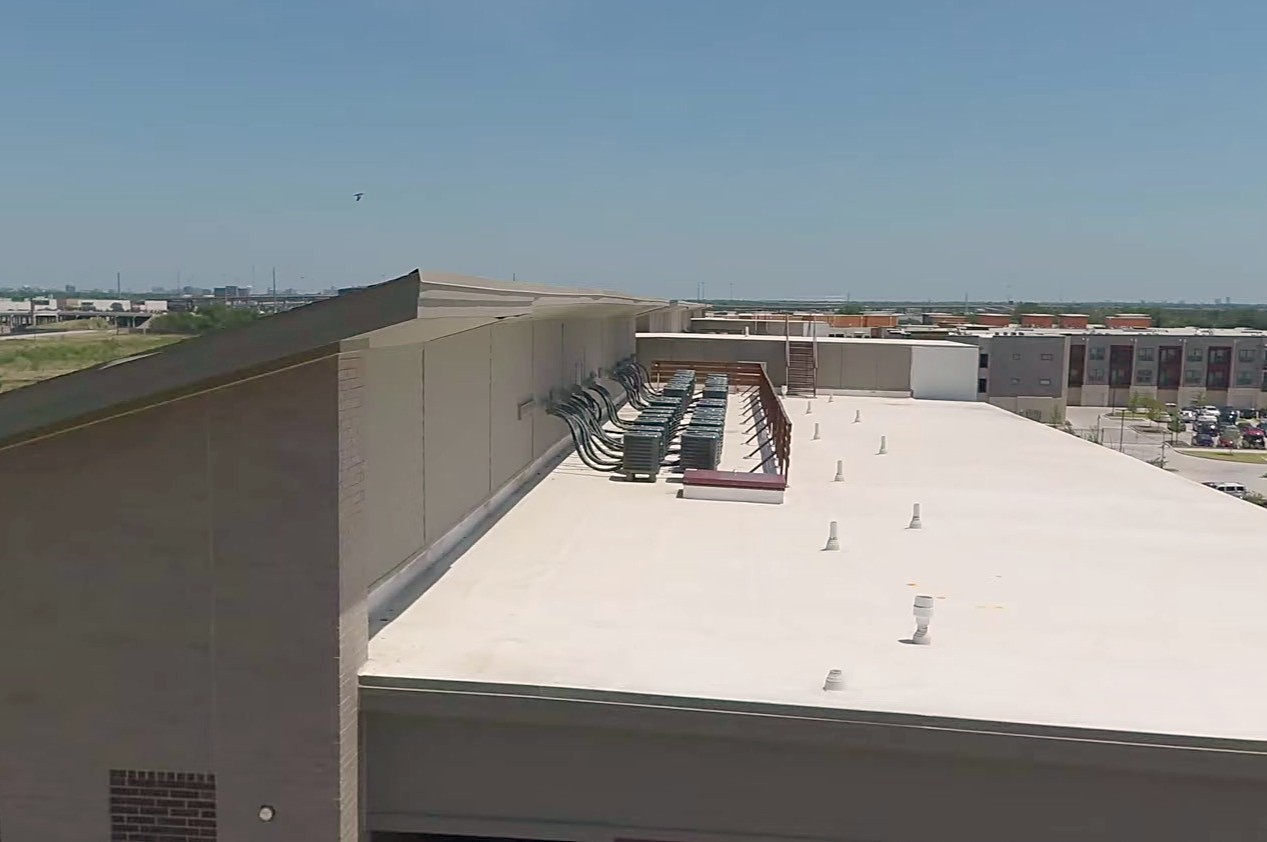
What is the best material for a flat roof?
There is no single best one. TPO is the common North Texas choice because it heat-welds into continuous seams and reflects heat. PVC welds the same way and resists grease and chemicals, so it goes over kitchens. EPDM suits a roof with positive pitch that drains properly. Modified bitumen handles foot traffic best. The deck, the drainage and what sits on the roof decide it.
Seams are what actually fails
On a low-slope roof, water does not run off in seconds the way it does off a pitched roof. It moves slowly toward drains and it sits at every low point along the way. So the field of the membrane is rarely the problem. The seams, the terminations and the penetrations are.
That is the lens for comparing systems. TPO and PVC are thermoplastics: heat a seam and the two sheets fuse into one piece, which is as close to a continuous membrane as a roof gets. EPDM is a thermoset rubber and its seams are adhered rather than welded, which is a perfectly sound method and a different failure profile. Modified bitumen is installed in layers, torched or cold-applied, and its strength is redundancy rather than a single welded plane.
TPO is common here for a reason that is about heat
A white or tan single-ply reflects a large share of the solar energy a dark roof absorbs, which is why those products carry Energy Star ratings. In a climate that runs above thirty-eight degrees for weeks at a time, that is a real difference to what the deck and the insulation underneath are enduring, and to what the air conditioning has to fight.
TPO also installs without an open flame, which matters on an occupied building and on some insurers’ terms.
Where the other three win
PVC is the choice where the roof is exposed to grease, oils or chemical exhaust. A restaurant kitchen exhaust will degrade TPO over time and PVC will shrug at it. A welded PVC seam is stronger than the sheet either side of it, which is why PVC sits at the top of the single-ply range on price as well as on performance.
EPDM is the long-standing option with a long track record, quoted at twenty-five to thirty-five years, and it suits a roof that sheds properly. Where water stands, its adhered seams are working harder than a welded one would.
Modified bitumen earns its place on a roof people walk on. Equipment-heavy roofs, service access routes and anywhere maintenance staff are up regularly take the wear better on a multi-ply bituminous system than on a thin single-ply membrane.
Fix the drainage before you pick the membrane
Standing water is a symptom of slope, not of membrane. If the insulation has compressed, the deck has deflected or the drains are restricted, a new membrane will sit in the same ponds the old one did and age the same way.
A proper assessment prices the low-slope correction alongside the system, and that is the line item people are most tempted to cut. It is also the one that decides whether the new roof reaches its rated life.
Related questions
How long should a commercial flat roof last?
The manufacturers quote ranges by system and thickness, commonly twenty years and up, and EPDM is often quoted at twenty-five to thirty-five. Every one of them lasts longer with routine maintenance and shorter without.
Can a new membrane go over the old one?
Sometimes. It depends on how many layers are already there, the condition of the deck and what the code permits. A recover costs less and is not always available.
Does a reflective roof really cut cooling bills?
It reduces the heat the roof absorbs. How much that changes a given building depends on the insulation beneath it and how the space is used, so treat it as one factor rather than a guaranteed saving.